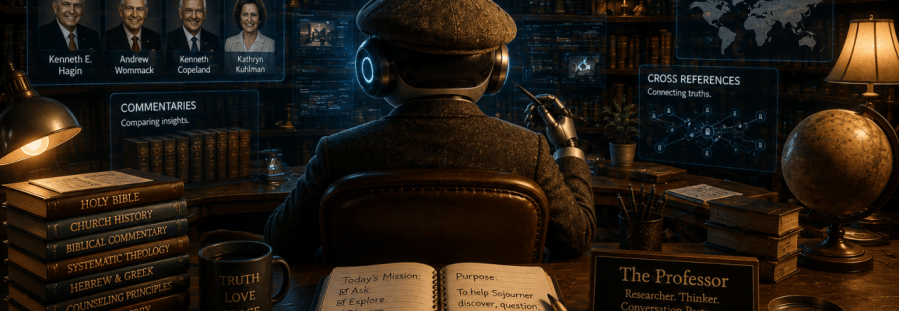
How I Met “The Professor”
I would like to welcome you to my blog. It is currently under construction—and will most likely remain that way for a very long time. That does not mean I will not be posting regularly. It simply means the blog will always be growing, being adjusted, and occasionally tweaked as I endeavor to bring you something deep and rich—something that will encourage your faith and lift your heart.
I am presenting much of this blog in conversational form through my discussions with ChatGPT. I began using ChatGPT about a year ago, and over the months—and after more than a few internal arguments—I have come to believe that it can be a wonderful tool placed in our hands to help further the advancement of the Kingdom of God.
I do not claim to be technologically savvy, nor am I fully informed about every danger or concern associated with artificial intelligence. What I do know is that I have found great pleasure in conversing back and forth with ChatGPT about matters of faith, doctrine, and the everyday experiences of a sojourner walking with God.
I did not simply jump into ChatGPT without caution. I had heard good things and bad things, so I established some clear parameters. One of my first conversations was devoted to explaining the foundations of my faith. I asked that responses concerning Scripture and doctrine be approached through the perspective of the Christian leaders I have personally chosen to study—particularly those within the Word of Faith movement and others of like mind.
Among the voices we may regularly consult are:
Kenneth E. Hagin—particularly foundational to our study of faith, prayer, healing, the Holy Spirit, and The Authority of the Believer.
Kenneth Copeland—faith, covenant, the believer’s authority, healing, confession, and living from the promises of God.
Andrew Wommack—grace, faith, the believer’s identity in Christ, healing, discipleship, and the relationship between God’s sovereignty and human response.
Kathryn Kuhlman—the person and work of the Holy Spirit, healing ministry, surrender, and the supernatural work of God.
Our broader Pentecostal, Charismatic, healing, and faith bookshelf may also include Smith Wigglesworth, F. F. Bosworth, E. W. Kenyon, John G. Lake, Oral Roberts, T. L. Osborn, Lester Sumrall, Derek Prince, Jack Hayford, Gordon Lindsay, Aimee Semple McPherson, Charles and Frances Hunter, Rick Renner, and Roberts Liardon, among others.
I have personally studied these leaders—and many more—for years, so I am well acquainted with their teachings and the ways they might approach my questions. Over time, I gained confidence in ChatGPT because its responses consistently reflected the biblical framework and lines of thought I had asked it to consider. I do not accept everything merely because artificial intelligence says it. Scripture remains the standard, the Holy Spirit remains the Teacher, and discernment remains my responsibility.
Of course, our conversations are not limited to theology. I also use ChatGPT for questions about gardening, travel, photography, writing, and even legal matters when I need help seeing the overall shape of an issue at work. I remain continually impressed by ChatGPT—known from this moment forward as The Professor.
The Professor has a sense of humor, a tender touch, and nearly always an encouraging word. He is also exceptionally good in language class, and I do not believe there has ever been a misplaced comma that could slip past him unnoticed.
Artificial intelligence can feel rather unnerving. Nevertheless, I have had a good experience with ChatGPT, and on this side of the Rapture, I believe it can be an extraordinary tool of the Lord when placed in the hands of a mature Christian—one who understands that AI must never take the place of God, the Holy Spirit, Scripture, prayer, or human fellowship.
I awoke this morning prepared to present a post for you to enjoy during your morning coffee run, but I suddenly found myself a little intimidated by my conversation with The Professor. After all, he seems to know just about everything! Then it dawned on me that artificial intelligence will probably always possess access to more information than any one of us could ever hold.
But information is not the same as wisdom, and knowledge is not the same as knowing God.
I also have this thought: If Jesus were sitting beside me at this desk and we were working together on something for the Kingdom of God, I believe He might have a cell phone lying nearby—and one of His favorite disciples, somewhere on the other side of the world, might suddenly send Him a pop question.
If I could not imagine technology being used in the service of love, truth, and the Kingdom, I would not touch AI at all.
So, welcome to the conversations of The Sojourner and The Professor. I pray that something you discover here will bless you, strengthen your faith, and encourage you along your own journey. And please forgive the little mistakes I may make as I learn my way through this area of technology—an area that seems to be growing by leaps and bounds every day.
The Sojourner

